Designing HomeEase: An Accessible Housing Search Experience
Designed an accessibility-first housing search experience, defining a core decision moment and building an MVP, user flows, and design system to support confident housing decisions.

Client:
HomeEase
Category:
UX Research, Marketplace , AI-Assisted UX
My Role:
Product Designer
HomeEase is a housing marketplace that helps people with support needs find accessible homes confidently.
This case study documents the end-to-end design of HomeEase, from research and problem definition to mid- and high-fidelity MVP designs.
It highlights how research insights translated into flows, wireframes, a focused MVP, and a scalable design system.
THE CHALLENGE
<6%
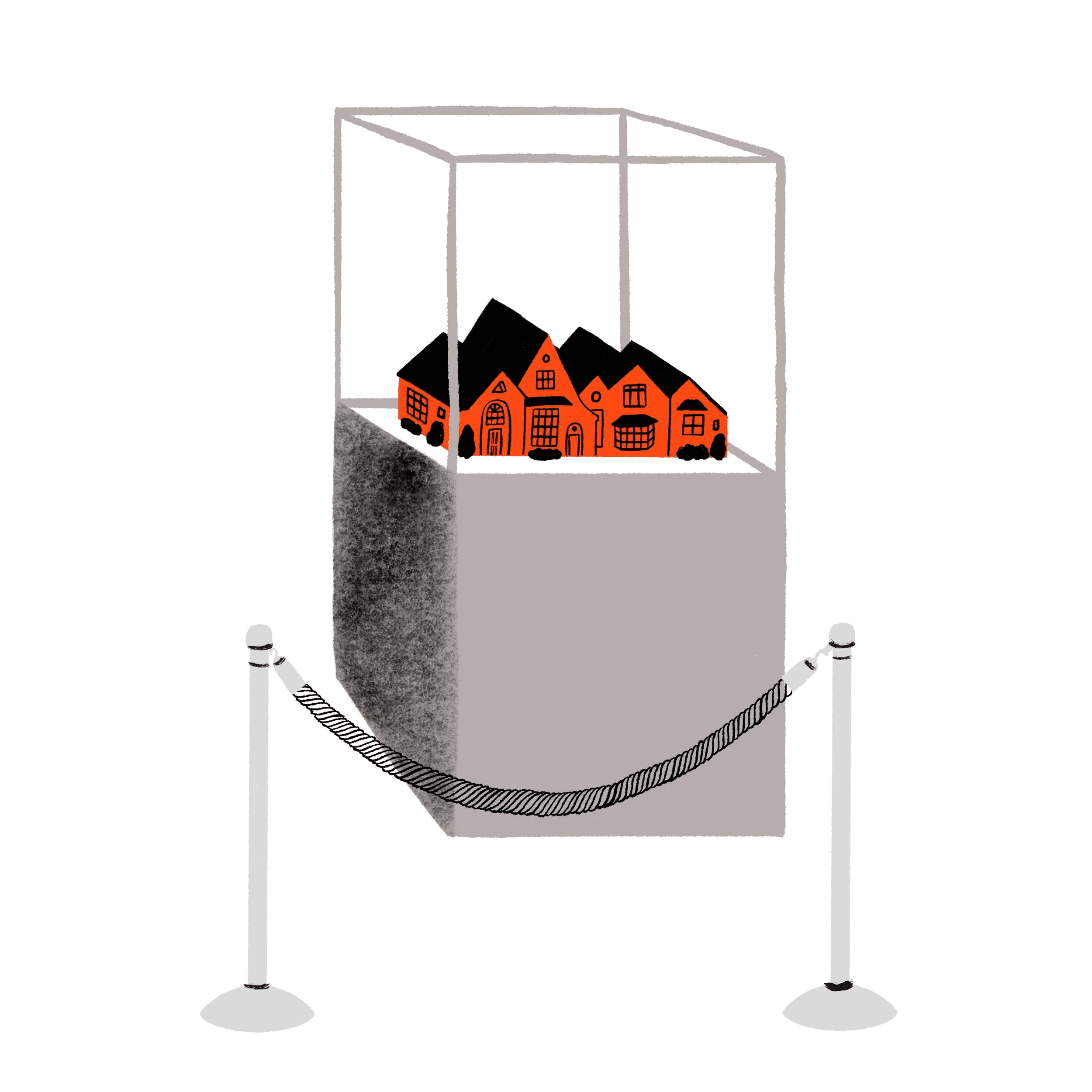
The Reality Behind “Accessible”
Millions of Americans struggle to find homes that genuinely meet their accessibility requirements.
Fewer than 6% of U.S. homes are accessible.
Over 900,000 NYC residents identify as having a disability.
Many reported that “accessible” listings frequently don’t match reality, leading to embarrassment, wasted time, or unsafe conditions.
Most existing platforms treat accessibility as an afterthought: a single checkbox, vague wording, or no verification.
Project Goal
Design an experience that reduces the emotional and logistical burden of verifying accessibility by making housing searches more transparent, personalized, and empowering.
THE research
Understanding the Lived Experience
To understand how individuals with accessibility needs and their caregivers navigate the housing search today, identify key barriers, and design a more inclusive, transparent, and empowering housing search experience.
User Interviews
5 individuals with mobility, sensory, or cognitive disabilities
3 caregivers supporting family members
1 accessibility advocate working with local organizations
Competitive Analysis
To benchmark how existing housing and travel platforms address accessibility.
Zillow
Apartments.com
Redfin
Airbnb
Synthesis and Mapping
Affinity clustering of 120+ observations to reveal recurring emotional and logistical pain points
Stakeholder mapping to define relationships among users, caregivers, realtors, and advocates
Journey mapping to identify friction
key insights
What we heard
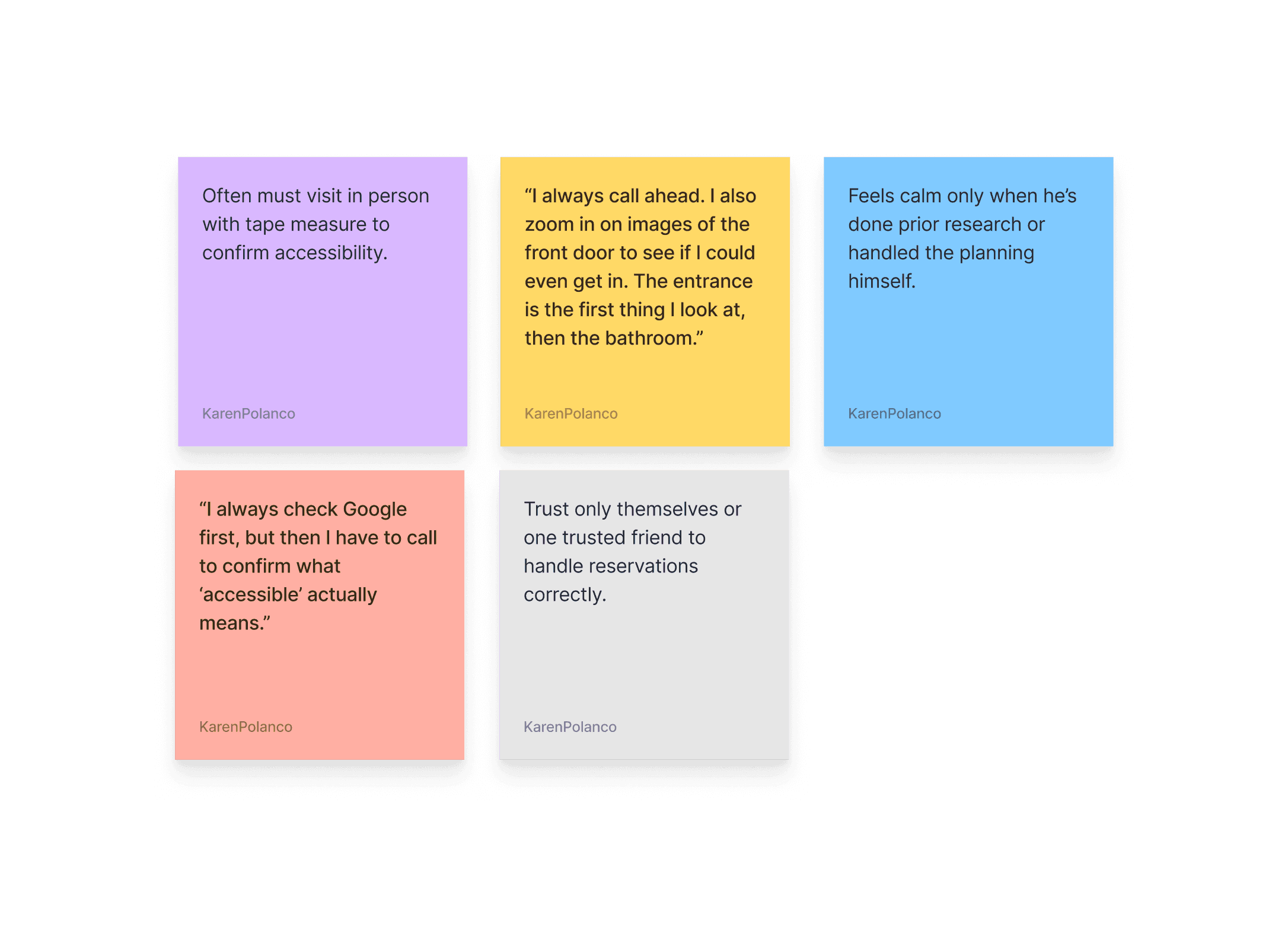
Across interviews, three consistent pain points emerged:
Accessibility misunderstandings cause embarrassment or frustration during outings
Mistrust of others to plan accessible outings
Inaccessible public spaces despite ADA claims


user persona
Meet Mary
A retired artist who uses a wheelchair after cancer treatment.

Mary’s Journey Map

THE approach
Turning insight into direction
The research pointed toward four opportunities:

Verified Accessibility Information
Trustworthy checklists, photos, and measurements help remove uncertainty.

Personalized Filters
Accessibility varies: mobility, sensory, cognitive. Users need filters that reflect their real requirements.

Community Feedback Loop
People trust lived experiences from others with similar needs.

Home modification suggestions
Users want help understanding modifications or usability before a visit.
FINAL DESIGNS
Introducing HomeEase
HomeEase is a housing discovery platform built for people with support needs.
It combines:
Verified accessibility listings
Personalized accessibility filters
Modification guidance powered by AI
Connections to accessibility-trained realtors
HomeEase helps users:
Clearly see whether a home fits their needs
Compare verified accessibility information
Understand modification possibilities
Save and share options with caregivers or professionals
Make confident decisions based on truth, not assumptions

Defining the MVP
The MVP focuses on one core moment: evaluating accessibility recommendations within a listing. To support that moment, the design includes onboarding, a basic homepage, and listing navigation.

The core experience
HomeEase simplifies the process through a 5-step flow: select accessibility needs, browse filtered listings, open a listing, review verified access information and AI recommendations, then save, share, or contact a realtor.

WIREFRAMES
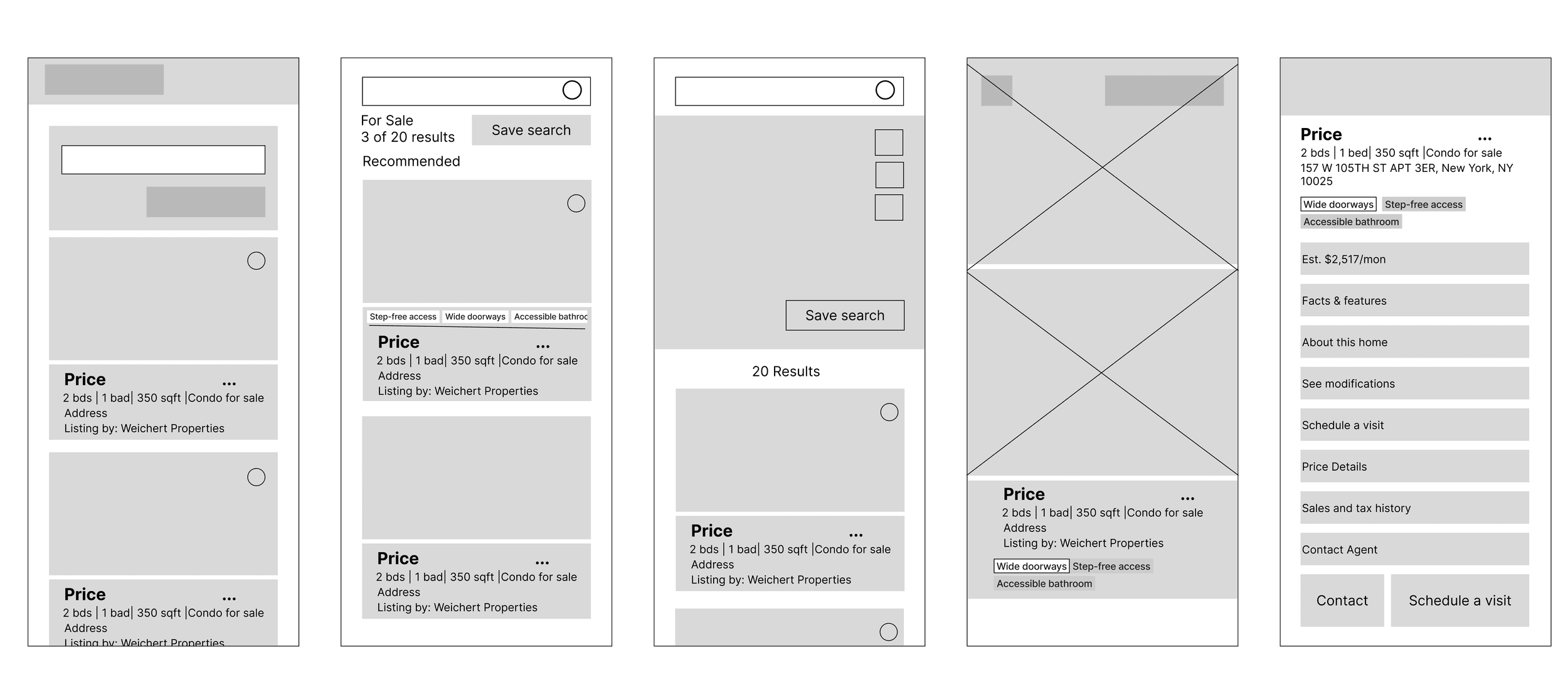
Validating the structure
Mid-fidelity wireframes focused on information hierarchy, reducing cognitive load, and making accessibility scannable before moving into higher-fidelity visual design.


FINAL DESIGNS
Refining the experience
High-fidelity designs refined: Accessibility indicators, trust and clarity, and a calm professional visual language that supports confident decision-making.

reflection
Designing beyond labels
This project emphasized that accessibility is not binary. Clear, honest information builds trust more than labels. HomeEase demonstrates how focused MVP design can address complex accessibility challenges.
Related Projects

